
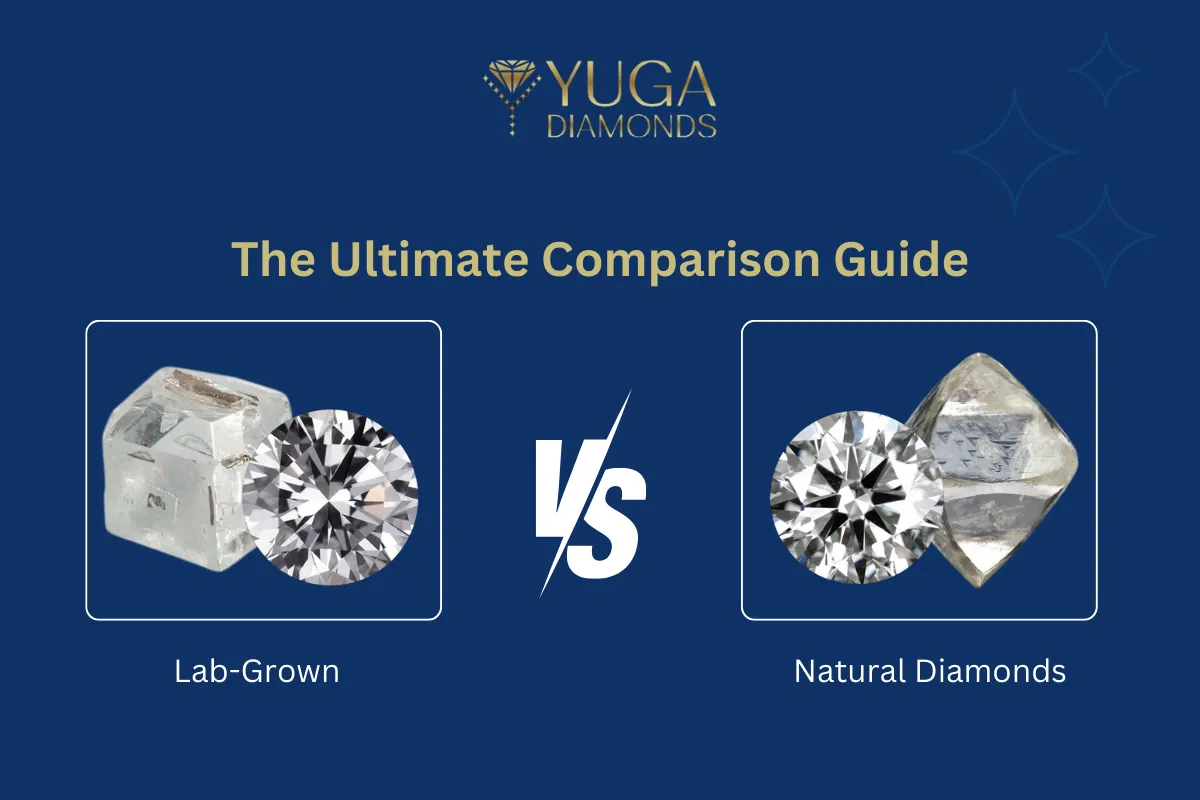
At Yuga Diamonds, we understand that choosing between lab-grown diamonds and natural diamonds represents one of today’s most significant jewelry decisions. As pioneers in the lab-grown diamond industry, we’re committed to providing transparent, comprehensive information to help you make an informed choice that aligns with both your values and budget.
Our expert gemologists have extensive experience with both lab-grown and natural diamonds, allowing us to offer unique insights into the characteristics, benefits, and considerations of each option.
When comparing lab-grown and natural diamonds, it’s essential to understand that both possess identical chemical, physical, and optical properties – they’re both genuine diamonds. The key difference lies in their origin story: while natural diamonds form deep within the Earth over billions of years, lab-grown diamonds are created in controlled environments using advanced technological processes that replicate nature’s methods.
At Yuga Diamonds, we specialize in certified lab-grown diamonds that offer the same exceptional quality as natural diamonds, often at 40-50% lower cost, while providing peace of mind through their ethical and sustainable origins. Also change Natural diamond to Mined (natural) diamond.
| Characteristic | Natural Diamonds | Lab-Grown Diamonds |
|---|---|---|
| Chemical Composition | Pure carbon crystal structure | Pure carbon crystal structure |
| Physical Properties | Hardness: 10 on Mohs scale | Hardness: 10 on Mohs scale |
| Optical Properties | Identical refractive index and fire | Identical refractive index and fire |
| Cost | Here mined higher price point e.g. 1ct round F color vs1 $4,500 – $6,000 | Here 60-80% less expensive than mined e.g. 1ct F Color vs1 loose diamond $500- $600 |
| Resale Value | Unlike gold, diamonds are not a universally liquid asset in both the categories. Mined diamonds lose value upon resale due to factors like market saturation, markups by retailers and competition in lab-grown diamond | Unlike gold, diamonds are not a universally liquid asset in both the categories. lab-grown diamonds lose value upon resale due to the underdeveloped market, making it harder to sell. |
| Size Availability | Hole in pocket to get 1carat eye clean mined diamond | Pocket-friendly to gift even a 3 carat F color VS quality diamond |
| Formation Time | 1-3 billion years | 2-4 weeks |
| Formation Process | Deep earth, extreme pressure and heat | HPHT or CVD technology in controlled environment |
| Origin | Mined from earth’s crust | Created in laboratory settings |
| Environmental Impact | Mining required; diamond mining harms the Earth through deforestation, habitat destruction, soil erosion, water pollution, greenhouse gas emissions, and extensive energy use | Minimal environmental impact; lab- grown diamonds are produced in controlled environments with significantly lower ecological disruption, reduced carbon emissions, and no habitat destruction |
| Certification | GIA (Gemological Institute of America), AGS (American Gem Society), IGI (International Gemological Institute), HRD (Hoge Raad voor Diamant), EGL (European Gemological Laboratory) | IGI (International Gemological Institute), GIA (Gemological Institute of America), GCAL (Gem Certification & Assurance Lab), HRD (Hoge Raad voor Diamant) |
Understanding Diamond Origins
Natural Diamonds: Nature’s Masterpiece

Natural diamonds form through an extraordinary geological process deep within Earth’s mantle, requiring specific conditions that have fascinated scientists for generations.
Formation Process
- Created 150-250 kilometers beneath Earth’s surface
- Requires temperatures between 900-1,300°C (1,652-2,372°F)
- Forms under pressure of approximately 50,000 times atmospheric pressure
- Carbon atoms crystallize under these extreme conditions
Transportation to Surface
- Carried by kimberlite and lamproite volcanic eruptions
- Rapid ascent through volcanic pipes prevents diamond degradation
- Explosive eruptions create diamond-bearing deposits
- Forms in specific regions called “diamond stability zones”
Lab-Grown Diamonds: Modern Innovation

Alt: Lab-Grown Diamonds Origin
Lab-grown diamonds are created using two primary methods that replicate natural formation conditions:
HPHT (High Pressure, High Temperature)
- Uses diamond seed placed in carbon source material
- Temperatures reach 1,300-1,600°C
- Pressure exceeds 870,000 pounds per square inch
- Growth period of several days to weeks
CVD (Chemical Vapor Deposition)
- Utilizes diamond seed in sealed chamber
- Chamber heated to approximately 800°C
- Carbon-rich gases ionized into plasma
- Diamonds grow layer by layer
Quality Assurance
- IGI certification confirms authenticity
- Graded using same 4Cs as natural diamonds
- Identical chemical and physical properties
- Advanced testing equipment verifies quality
- Here’s a detailed comparison table of key differences between natural and lab-grown diamonds:
Making the Choice: Natural vs Lab-Grown Diamonds
At Yuga Diamonds, we believe in providing comprehensive information to help you make an informed decision. Both natural and lab-grown diamonds are chemically identical, with the same optical and physical properties. The key differences lie in their origin, price, and market value.
| Characteristic | Natural Diamonds | Lab-Grown Diamonds |
|---|---|---|
| Formation Time | 1-3 billion years | 2-4 weeks |
| Origin | Earth’s mantle, 150km deep | Laboratory setting |
| Price | Higher market value | 60-80% less expensive |
| Resale Value | Better value retention | Lower resale value |
| Certification | Primarily GIA | Primarily IGI |
| Availability | Limited by nature | Consistent supply |
Physical Properties
Both types of diamonds share identical characteristics in terms of durability and beauty:
- 10 on Mohs hardness scale
- Same optical properties
- Equal brilliance and fire
- Identical chemical composition
Growth Characteristics
Natural diamonds form deep within the Earth, containing tiny amounts of nitrogen as trace elements. Lab-grown diamonds are created through either HPHT (High Pressure High Temperature) or CVD (Chemical Vapor Deposition) methods, containing no nitrogen – a key identifier used by gemologists.
| Growth Method | Temperature | Process | Duration |
|---|---|---|---|
| Natural | 900-1,300°C | Earth’s pressure | Billions of years |
| HPHT | 1,500-2,000°C | Lab pressure | Few weeks |
| CVD | 800-1,300°C | Gas chamber | Few weeks |
Making Your Decision
Consider these key factors:
- Budget constraints
- Size preferences
- Environmental concerns
- Investment intentions
- Personal value
Why Choose Yuga Diamonds for Your Diamond Journey
Experience and Expertise
With over 20 years of dedicated service in the diamond industry, Yuga Diamonds offers comprehensive in-house expertise from stone-cutting to final design. Our team handles every aspect of creation, including manufacturing, designing, and quality control, ensuring superior craftsmanship in every piece.
Certification and Quality Assurance
We provide diamonds certified by prestigious laboratories:
- IGI certification for lab-grown diamonds
- GIA certification for natural diamonds
- Detailed grading reports for every stone
- Independent quality verification
Diamond Options
At Yuga Diamonds, we offer:
- Both natural and lab-grown diamonds
- Customized jewelry designs
- Extensive selection of styles
- Various price points to suit different budgets.
Comprehensive Services
Our services include:
- Custom design consultation
- Expert gemologist guidance
- Quality control inspection
- Worldwide shipping
- After-sale support
Transparency and Trust
We prioritize:
- Detailed documentation of diamond characteristics
- Clear pricing structure
- Educational resources for informed decisions
- Complete disclosure of diamond properties
Customer-Centric Approach
Our commitment includes:
- Personalized consultation
- Custom design options
- Flexible financing through Affirm
- Dedicated customer support
- Lifetime warranty
Begin your diamond journey with Yuga Diamonds today. Schedule a consultation to explore our collection and find your perfect piece.